

1 - What Markets are Pricing
At the recent FOMC meeting, Chair Kevin Warsh stressed that inflation is the Fed's key concern and that the Committee will be unwavering on its 2% target. They effectively shared that they would be willing to accept some softness in the labor market to get there. The Fed has a dual mandate to manage both employment and inflation, and their clear emphasis on the latter is what markets are now pricing in. Markets are now pricing in around three rate hikes in total, with roughly two more to come. This can be largely attributed to the supply-driven inflation shock, as seen in oil and its refined products, which has risen sharply. It has forced the Fed to opt for more restrictive rates to mitigate the downstream impact of a rising cost in the lifeblood of the economy.
In our view, markets may be pricing in too many additional hikes, though it may not imply easing financial conditions. While we would still need to see upcoming economic data, our current base case is one additional rate hike, before normalizing at an extended period of restrictive rates. We believe the important question is how these rates repricing transmits across risks assets. Although from what we will see in corporate credit later, this has remained relatively contained. Broad credit deterioration consequently may not be the key issue but rather if investors are sufficiently compensated for additional incremental credit risks taken.
Here's what the data says and what we think about it.
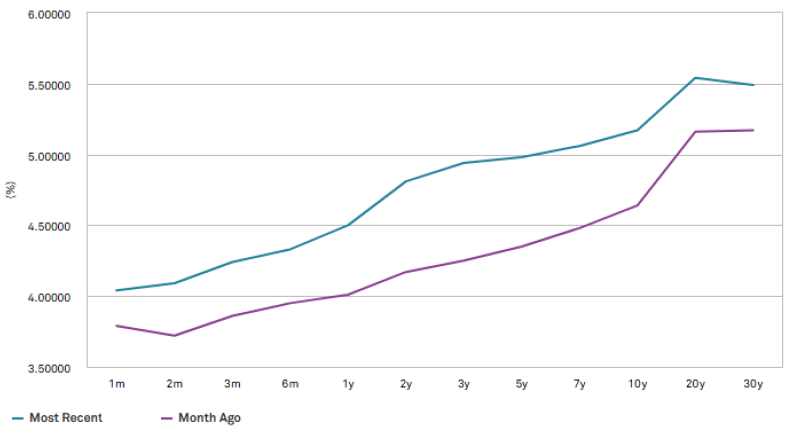
Data as of Sept 25, 2026 | Source: S&P Capital IQ
One of the most essential things to watch in markets is the yield curve. It actively reflects what the market expects in the near term and long term, which makes it one of the most important signals. What we see from the yield curve now is what is known as a bear steepening. This in other words means that the long end is rising faster than the short end, because term premium and risks over the long run are increasing, and investors want to be compensated for taking on these risks for a longer duration.
Why yields are being pushed higher:
- Fiscal uncertainty: US debt levels recently crossed $40 trillion. Amid geopolitical tensions, investors expect compensation for increasingly elevated risks.
- Growth Prospects: The S&P 500 grew 26% over the past four quarters and is projected to reach 8,700 within the next 12 months. Investors are demanding higher yields to justify the opportunity cost of not investing in equities.
- Inflation Expectations: Recent data shows inflation remains sticky despite Fed rate hikes. Persistent inflation means the Fed keeps rates higher for longer.
The front end of the yield curve effectively front-runs near-term Fed decisions. Shorter term yields price near term market expectations of upcoming policy moves. On the other hand, the long end reflects broader concerns (i.e fiscal policy, inflation dynamics, term premiums)
Other factors are being priced into the elevated term premium. Bond vigilantes (large foreign and private holders) are actively trimming US treasury exposure amid debt concerns and geopolitical risks. Alongside elevated issuance levels, there is persistent upward pressure being placed on long-end yields. Markets are consequently pricing in sustained higher rates, as reflected in the curve.
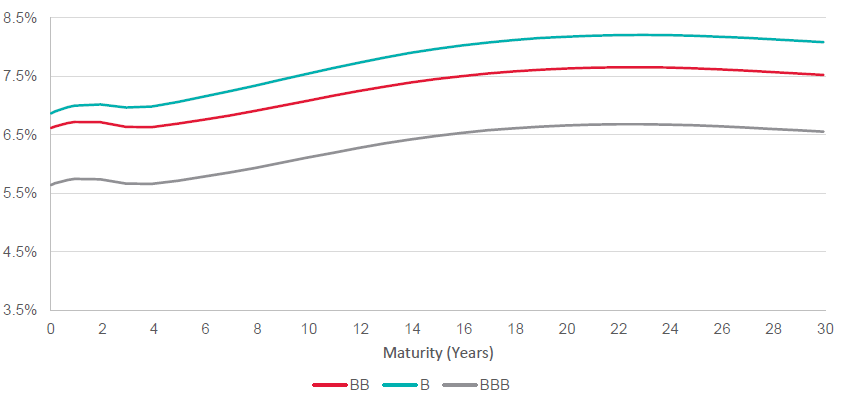
Latest Data as of Sept 25, 2026 | Source: S&P Capital IQ
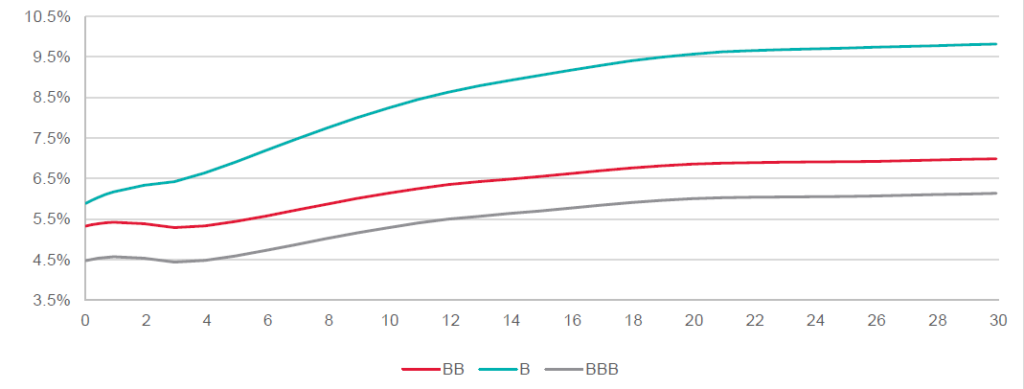
Data as of Sept 25, 2025 | Source: S&P Capital IQ
Despite the repricing we've seen in Treasury yields, corporate credit spreads have remained relatively contained. Credit yields across B, BB and BBB corporate bonds have risen materially over the past year, by roughly 100 b.p.s in the short to medium term.
Simultaneously, the gap between B and BB-rated bonds has significantly narrowed. Just a year ago, investors had demanded a clearer premium for holding B over BB-rated credit. Since then, however, that same premium has narrowed significantly, with both the curves sitting much closer together across most maturities. Investors may becoming demanding less incremental yield for additional risks taken on lower quality credit risks.
We believe this is something to keep a closer lookout towards. In an increasingly restrictive rate environment, balance sheet resilience matters all the more, even as broader markets may seem contained. B-rated credit companies may have higher exposure to risks such as more leverage and less cash flow buffers. This could potentially reduce leeway for errors as financing costs would rise. If rates continue to reprice higher without widening in B-rated spreads, we think that investors may not be adequately compensated for additional incremental risks taken. Therefore, we believe credit selection should matter all the more than what markets could be pricing currently.
Historically, this type of spread compression tends to be less stable. The gap between B and BB-rated debt typically widens again once credit conditions weaken, thus requiring close watch.
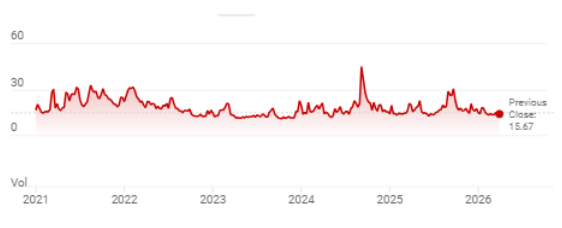
Data as of Sept 25, 2026 | Source: Yahoo Finance
The VIX index currently sits at 15.67, below its long-term historical average. A VIX at this level implies calm and reduced severe near-term risk. Historically however, this has tended to come before periods of rising volatility. This is particularly true as markets move through the choppier stretch from late August into October.
From our perspective, the moderate VIX reinforces the broader observation that risk premium remains relatively contained. A low VIX reading should be read alongside the other data points covered. Taken together with the data discussed previously, equity and bond markets are both pricing in a positive near-term outlook. The same reach-for-yield behaviour showing up in credit markets appears in equity volatility, suggesting a broader willingness across asset classes to look past near-term risk.
Credit spreads between B and BB-rated bonds have narrowed, indicating investors could have strong growth confidence in what is seen as a favourable credit environment. Investors are not being selective about yields and willing to take on more incremental risks. As of September 21st, the VIX appears to mirror the same sentiment, at 15.67. Equity and credit markets appear confident in the near-term outlook, which we think is to be questioned for the reasons below.
Generally, in the face of a rising-rate regime with higher-for-longer rates, the longer dated cash flows are most heavily repriced. This is because as the discount rate rises, the net present value after discounting would drop heavily.
While AI has proven resilient, it is not immune to higher rates. Much of its value depends on revenue years from now, funded by heavy capex today, so higher discount rates weigh on it more. Even so, we think the case still holds, because earnings are compensating. S&P 500 EPS grew 51% year on year in the second quarter, with Goldman Sachs attributing almost half of this year’s earnings growth to AI investment. Earnings have outpaced prices, which has caused the forward P/E levels to fall to around 19 from above 22 at the start of the year. This shows the growth has been showing up in profits. The key variable we will track is whether that continues.
Though higher rates reduce the margin for error and increase funding costs, by itself, it does not break the case. The AI value chain can be broken down into hyperscalers, hardware suppliers, and software companies. For hyperscalers funding the heavy capex, the question is whether returns on that spending exceed the cost of financing it. For chip and hardware suppliers which earn revenue from that spending, the risk is that it slows. According to Goldman sachs, the boost from AI investment is expected to fade by 2028. For software and application companies, the question is more about their ability to retain their pricing power and retain clients.
Across all three, the principle is that AI will continue to be invested into and creating value only if returns on the capital invested exceed its cost. The key variable we will track is whether that gap narrows. Beyond the headline growth, the quality and reliability of those cashflows actually materializing should matter all the more. As such it would be important to consider a company’s concentration, credit quality of customers, leverage, and the payoff duration. These all matter, because weaker credit quality increases risks of delayed or lost revenue and extended payoff periods makes valuations more rate sensitive. This is especially relevant because of the sheer scale of current AI capital expenditure. The investment case therefore depends not only on growing AI demand, but whether that demand translates into sustainable revenue, earnings and cash flow. We are actively watching commoditization pressures as open-source models potentially threaten to erode pricing power of frontier AI.
3 – Key risk that could invalidate our thesis
Since supply-driven inflation sits outside the Fed’s direct control, it’s hard to say with confidence where markets go from here. If oil prices or refining costs, the cost of converting crude into key refined products, continue rising, hawkish rhetoric is likely to stay intact and potentially prolong. The crack spread, a useful gauge of refining margin pressure, has risen meaningfully from around 42 in April to above 68 by late September. A continued squeeze in refining capacity would pressure fuel prices independent of crude itself, keeping the Fed hawkish for longer. Conversely, should geopolitical tensions ease and refining capacity improve, that pressure could unwind and ease inflation concerns through this channel. It’s difficult to know which way this resolves, and we believe predicting it with confidence would be a mistake.
Consequently, we position for both outcomes with a slight tilt towards our base case that the markets could be pricing in 1 more rate hike than we expect. However, this doesn’t change our thesis that rates could still remain restrictive for an extended period. This is driven by our belief that there could be less room for additional hikes than what the markets anticipate at the moment.
Another of our bigger concerns is a risk we don’t think markets are fully pricing: that we may be further along in the business cycle than consensus reflects. This isn’t clearly visible in equities, but it shows up in credit. The compression between B and BB-rated spreads discussed earlier suggests investors are being paid less to discriminate on credit quality right as that discrimination should matter more. This is why we believe being selective about credit quality matters more now than waiting for confirmation that conditions have turned. We flagged similar risks building in consumer and private credit around the same a year ago in Rebound or Reset: Turning Point Investors Can’t Ignore, and we continue to watch this space closely as this cycle progresses.

Image from Vector Stock
4 – Implications for Singapore
Everything we have mentioned thus far affects Singapore for two key reasons. The first is the exchange rate. MAS conducts monetary policy through the S$NEER rather than interest rates, with price stability as its objective. It has tightened twice this year, raising the slope of the policy band in April and again in July, as core inflation was expected to rise. As an economy that imports almost all its energy, Singapore is directly exposed to the oil and refining shock discussed above. A stronger Singapore dollar is MAS’s main tool for containing imported inflation. However, the trade-off faced is some loss of export competitiveness, though growth is currently being supported by the AI-driven tech cycle, which links Singapore’s outlook to our AI thesis in Section 2.
The second channel is interest rates. Because MAS manages the currency rather than rates, despite some divergence, domestic rates such as SORA largely follow global rates. A higher-for-longer Fed feeds into Singapore mortgage and corporate borrowing costs.
This is where duration-sensitive assets come under pressure. Property developers face higher mortgage rates that dampen buyer demand, and higher discount rates on project cash flows that take three to five years to realise. REITs with long-dated cash flows are more exposed still, particularly those that need to refinance debt at higher rates. This is the local equivalent of the balance-sheet resilience we flagged in credit. With rates higher for longer, duration and refinancing risk may matter more than headline yield. We would therefore be cautious on highly leveraged, refinancing-sensitive assets, and favour businesses with shorter cash-flow cycles, local demand and pricing power, such as domestic consumer staples.
About the Author